


Which matcha grade suits your taste and routine?
Which matcha grade is best? Start with how you plan to drink it: plain, in a latte or in recipes. A simple guide to grades, taste and value…
Country, language & currency
or
The Tea Journal · Brewing Guides · Matcha
By the Tealyra Tea Team · · 5 min read

In short: to make matcha tea at home, sift 2 g of matcha (about 1 teaspoon) into a bowl, add 2 oz (60-70 ml) of water at 165-175°F (75-80°C), and whisk briskly in a zigzag "M" or "W" motion for 15-20 seconds until a fine foam forms. Drink it right away. Everything else, from lattes to thick koicha, is a small change to these three steps.
Matcha has a reputation for being fussy, but a good bowl takes about two minutes once you know the ratios. Here is the method we use every morning, the tools that make it easier, and the mistakes that cause clumps and bitterness.
You can start with what you already have in the kitchen, but a few simple tools make a real difference to texture.
You will find whisks, scoops, bowls and sifters together in our matcha accessories. If you are choosing your first whisk, read how to choose a matcha whisk and look after it.
Use this table as a starting point and adjust to taste.
| Style | Matcha | Water or milk | Water temperature |
|---|---|---|---|
| Usucha (thin, everyday) | 2 g (1 tsp) | 2-2.5 oz (60-70 ml) water | 165-175°F (75-80°C) |
| Koicha (thick) | 4 g (2 tsp) | 1-1.3 oz (30-40 ml) water | 160-170°F (70-77°C) |
| Larger mug of matcha tea | 2-3 g | 5-6 oz (150-180 ml) water | 165-175°F (75-80°C) |
| Hot matcha latte | 2 g | 1 oz (30 ml) water + 6 oz (180 ml) steamed milk | 165-175°F (75-80°C) |
| Iced matcha | 2 g | 2 oz (60 ml) water + 6 oz (180 ml) cold water or milk over ice | 165-175°F (75-80°C), or whisk cold |
Usucha, or thin tea, is the everyday style described above: light, frothy and gently sweet with a fresh, grassy edge. It is the best way to taste a new matcha.
Koicha, or thick tea, uses twice the powder and half the water. Instead of whisking hard, you knead the matcha slowly with the whisk until it looks like glossy, runny paint, with no foam. It is rich, smooth and intensely savory, and it needs your best ceremonial grade, such as Samurai Matcha Ceremony. A lower grade turns bitter at this strength.
A latte is the most popular way to drink matcha in North America, and it is forgiving with any grade.
For lattes, smoothies and baking you do not need a top ceremonial grade. Culinary Matcha has a stronger, bolder flavor that stands up to milk and sugar. Not sure which grade suits you? Our guide on which matcha grade suits your taste and routine explains the differences, and you can browse every option in our matcha powder collection.
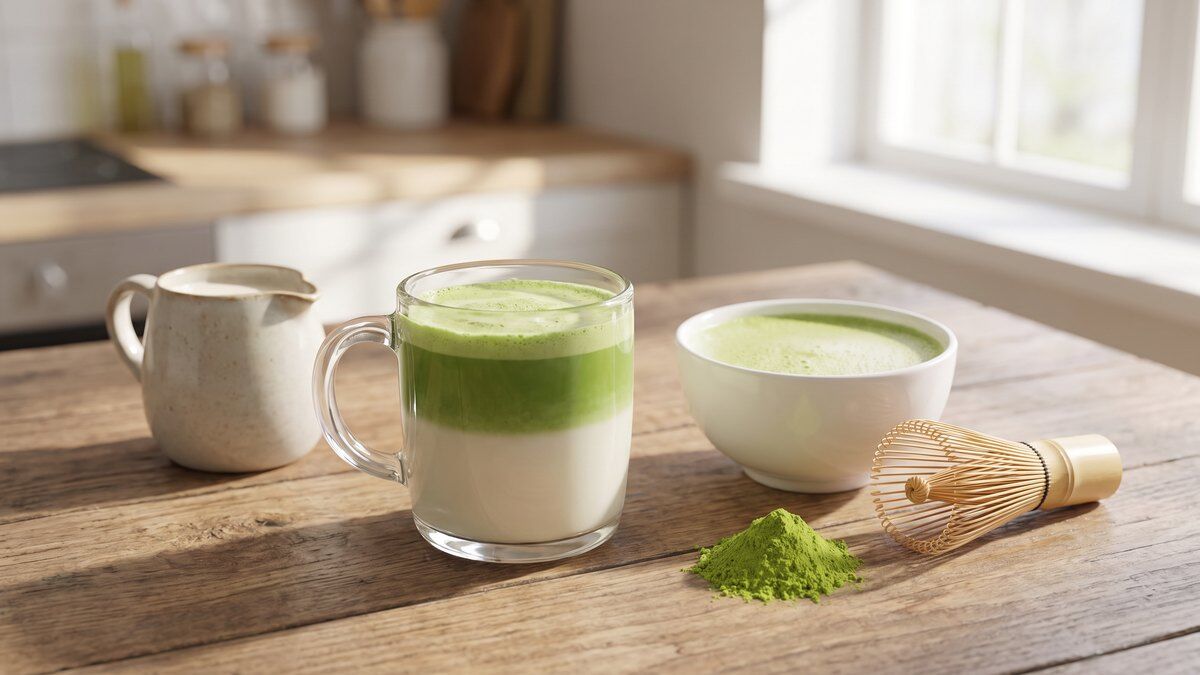
Prefer it cold? Try our recipe for iced matcha, which you can shake in a jar with no whisk at all.
Yes. Shake the matcha with water in a small sealed jar for 20-30 seconds, or use a handheld electric frother. The foam will be coarser than with a bamboo whisk, but the flavor will be smooth if you sift the powder first.
Use about 2 g (1 teaspoon or 2 bamboo scoops) for a traditional bowl or a latte. Use 4 g for thick koicha, and 2-3 g if you want a larger mug of matcha tea.
165-175°F (75-80°C) works for most matcha. Higher grades and koicha taste sweeter a little cooler, around 160-170°F (70-77°C).
Yes. Because you drink the whole powdered leaf, a cup of matcha has noticeable caffeine. See does matcha have caffeine for a cup-by-cup comparison.
The usual causes are water that is too hot, too much powder for the amount of water, or a culinary grade drunk straight. Cool the water to about 175°F (80°C) and try a ceremonial-style grade for plain matcha.
Which matcha grade is best? Start with how you plan to drink it: plain, in a latte or in recipes. A simple guide to grades, taste and value…

How to tell if matcha powder is high quality: judge the color, aroma, texture, taste and ingredient list together, not one label or a…

How to make strawberry matcha at home: a strawberry base, whisked matcha and milk layered over ice. Easy steps, plus tips to adjust…